Friday, January 15, 2016

Yaxchilan & Bonampak, Chiapas

Our next set of destinations were in the Lacondon rainforest, on the border with Guatamala.  The Lacondon rainforest is the largest rainforest in North America, and the second largest in the Americas in general (behind to the Brazilian rainforest).

Yaxchilan

Yaxchilan is located on the Usumacinta river which divides Mexico and Guatemala.  The site is located on a tear-shaped peninsula, which is only reachable by boat as there are no roads leading to the site.  The boats are long narrow canoes powered by an outboard motor.  After balancing out our party so as not to tip our transportation, we commenced a nearly 45 minute ride to the archaeological site.  On the way, we saw several crocodiles sunning themselves on the Guatemaltecan side of the river, as well as numerous howler monkeys in the trees.

Yaxchilan was a powerful city on the river for roughly 400 years, as it was one of several who could control trade up and down the river which runs all the way to the Gulf of Mexico.  The site is divided into three main areas: the Great Plaza, the Grand Acropolis, and the Small Acropolis. 

One of the interesting features we noticed about the structures in this region, different from those encountered on the Merida region, were the roof combs.  This site also retains some beautiful lintels in the structures, and a variety of frescos and mural remnants.

Bonampak

After Yaxchilan, we traveled further into the Lacondon region, to Bonampak.  The archaeological site of Bonampak is administered by the autonomous Lacondon peoples.  It is such that you can near the site, but then park your vehicle, and hire Lacondon transportation to the site.  The natives then also have the opportunity to sell their beautiful wares in the entrance to the site.  They make incredibly beautiful jewelry from the wide variety of seeds that can be found in the rainforest.  Additionally, you can find hand carved figurines and kitchen utensils made of the local mahogany wood, called Caoba.  Given the repression they have suffered over the years, we were happy to provide economic support through our visit.
Bonampak was inhabited as early as 100 AD , and its habitation ran roughly through 600-800 AD. Surprisingly, it is believed that there was an amicable relationship between Bonampak and Yaxchilan, just 12 miles away, as the rulers at one point were brothers-in-law and joined forces in at least one battle. 

What Bonampak is perhaps most well-known for are its lintels and the murals that adorn the interior of Temple 1.  Each visitor has the opportunity to spend up to 3 minutes in each room and no more than 3 people are allowed in a room at a time.  But the wait is definitely worth it!  The site of the murals and the stories they tell are quite impressive.


Tuesday, January 12, 2016

Palenque, Chiapas

Our first day in the rain-forest we hiked the Palenque archaeological site in the rain and mist.  The Palenque site reached its prominence between 500-800 AD, under the rule of Pakal I and his son, Pakal II.  Due to inbreeding in the ruling class, it is rumored that Pakal had six fingers on each hand and six toes on each foot.  Under the period of rule of father and son, Palenque rose in prominence and fortification.

Quite in contrast to other sites we’ve visited in the past, it was almost magical to wander up and down the hills in the rain, the hills half obscured by the mist.  You really got a feel for what it was like to really live in a rain-forest.  It also provided a mystical atmosphere to the place.

The kids were particularly fascinated by the tomb of the Reina Roja (Red Queen), which you can view on the site.  They had seen a replica in the Anthropology museum of Mexico City which included some of the original contents.  In Palenque, we entered the top of pyramid and walked down a tunnel to find the original sarcophagus.

Palenque also boasts an extraordinary number of original frescoes.  You can climb all over the site with very little restriction and discover them throughout.  Some of the largest ones were in the patio where prisoners were held.  In our explorations, Matthew and I found a small room with a hole in the floor and a canal beneath it.  We presumed this may have been a bathroom facility. 

Probably one of the favorite surprise and delight elements of this stop was that we used the lower entrance instead of the main tourist entrance.  This gave us the opportunity to begin our walk through the rainforest, climbing up through the jungle paths, across bridges, seeing smaller residential structures first before progressing upward to the hills past some of the lower ceremonial edifices and finally culminating in the palaces and temples at the top of the mount.  It was a route much less traveled and also allowed us to truly appreciate the simpler structures on our way up to the “main event”.  It was also an experience more typical of that of the everyday Maya population during the period of time in which Palenque was occupied.


Monday, January 11, 2016

Mexico City - Xochimilco and Coyocan

Xochimilco

Xochimilco is located in the southern part of Mexico City, which was originally part of a large lake.  Here, the Aztecs strategically filled in sections of land to create small islands and floating gardens for their crops, which could be easily accessed through a system of canals. 

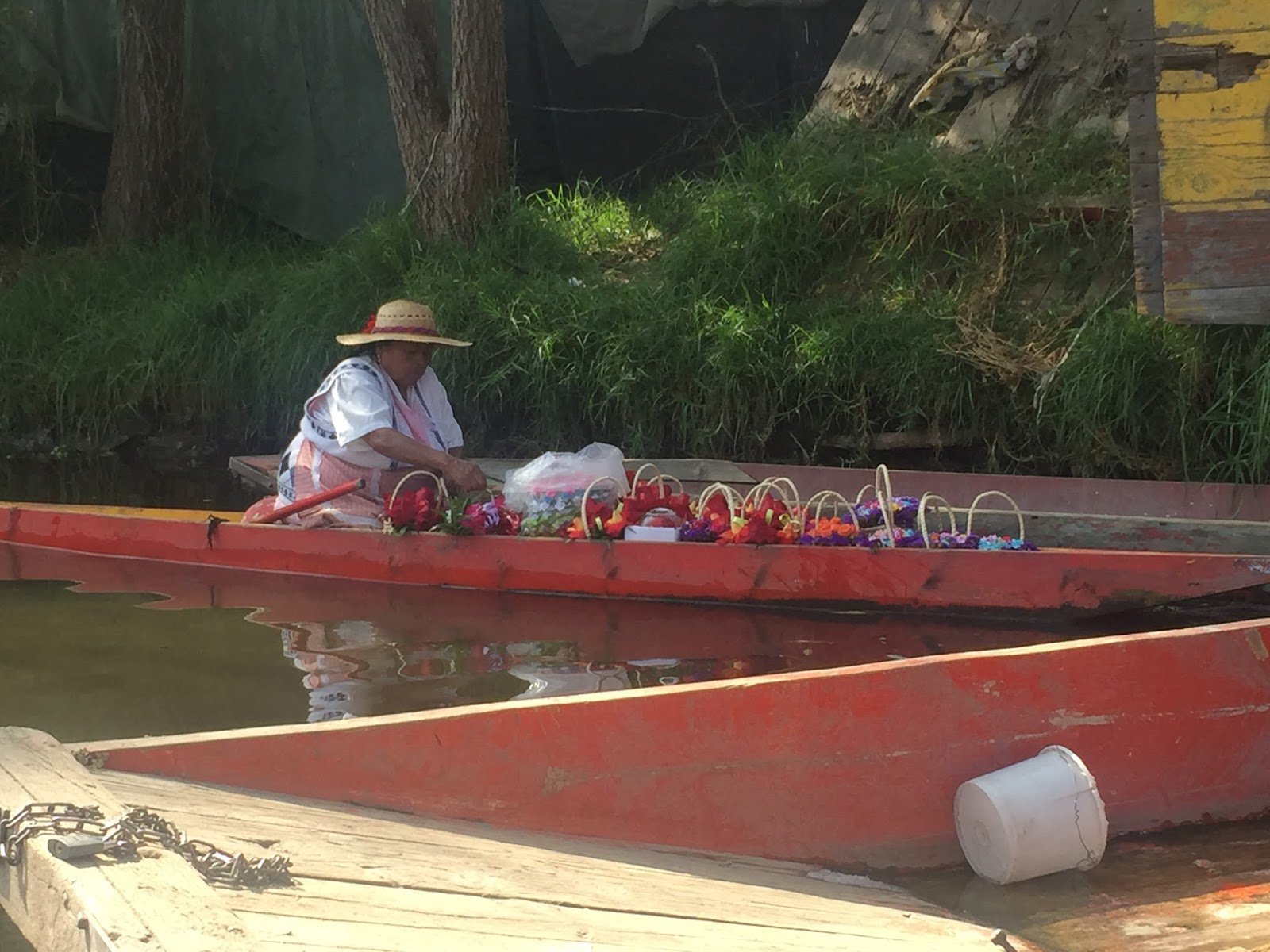
Over 60 kilometers of canals remain to this day, and many people come to visit and enjoy a leisurely boat ride on “trajineras” which are powered by boat pilots using poles to propel the crafts, which resemble a cross between a raft and a canoe, through the canal system.  Passengers sit on either side of the craft and a long table runs down the middle, ready for food, drinks, and merriment.  During the ride, you can still see many of the man-made islands, with greenhouses and small homes.  All are accessible purely by water.  Vendors approach in their own boats to sell food, flowers, jewelry, and other wares.  Musicians will happily rope their boat to yours to serenade you on your way.  It is a lovely way to spend an afternoon relaxing and in good company.
Coyocan

 Coyocan is a historical neighborhood in the south of Mexico City where the European elite lived, during colonial times.  The neighborhood retains its historic charm, and today it is known for its wonderful foods and ice creams.

There are also nearby plazas that hark back to the more difficult times of the inquisition.  It is hard to imagine the tragic events that occurred here, when walking the now peaceful and picturesque streets.  The relaxed atmosphere of Coyocan is really a world away from the hustle and bustle which you find in the rest of the mega-city that is Mexico City.

Sunday, January 10, 2016

Pyramids of Teotihuacan


Two years ago, we visited the pyramids of Teotihuacan and this year we went on a return visit.  Last time we began at one end of the 3 kilometer site and this time, we began at the other.  We explored the area around the Pyramide de la Luna (Moon Pyramid), the Quetzalpapalotl Palace, and finally the largest pyramid, Pyramide del Sol (Sun Pyramid).  


What is interesting about Teotihuacan is how large and prominent it was.  It was eventually abandoned; some believe it may have been due to a drastic drought where crops withered and died. 

We had an enjoyable hike around the site, which included a climb to the top of the Pyramide del Sol (Pyramid of the Sun), the larger of the two pyramids.  It provided a beautiful view of the entire site!


Saturday, January 9, 2016

Mexico City - Chapultepec

In the middle of Mexico City, is a huge park known as the lung of Mexico City, Chapultepec.  Chapultepec is the home of many, many fantastic museums as well as the Castillo de Chapultepec.  You can also find a lake, a zoo, and an amusement park within Chapultepec.  Of the many choices of things to do and places to visit, we made it to two: The Anthropology Museum and the Castillo de Chapultepec.


Museo Nacional de Antropologia e Historia
  
The Museo Nacional de Antropologia e Historia is a fantastic history and anthropology museum that resides in a space of over 93,000 square feet of material.  The kids enjoyed a large number of dioramas that depicted the evolution of the hominids throughout the ages, along with the changes in their tools, and the progression of their lifestyle from hunger gatherers to early agricultural techniques.  After that baseline, we explored the ancient peoples and artifacts of the different populations in each region of Mexico.  We got to see replicas of the cave paintings found in Baja California.  We saw replicas of the cliff dwellings found in the desert regions of northern Mexico and the four corners area of the US (Arizona, New Mexico, Utah, and Colorado).  Particular fun was finding the famous Aztec calendar (which may not actually be a calendar), and the giant stone heads created by the ancient Olmec peoples.  We also got a preview of what is yet to come when we visit the Mayan ruins in Chiapas, later this trip, and a review of the Mayan artifacts we learned about on our last trip.  All in all, you could easily spend a week in this museum and still not take everything in.  Half a day was really enough to whet our appitites for a return visit sometime.

Castillo de Chapultepec

The Castillo de Chapultepec is a castle found in the Chapultepec park that was the home of Maximillian and Carlotta.  Maximillian was of the Hapsburg family in what we now know as Austria, and a cousin to Napoleon.  He was put in charge of the colony of New Spain (Mexico).  His wife, Carlotta, was the daughter of a Belgian king.  Located high on a hill, the Castle provides a view of how the designated governors of New Spain clung to their European roots.  The décor is very European, and the furnishings and instruments were directly imported from the home continent.  The gardens are very much like those you’d find in residence of nobility in the homeland.  It is all quite opulent and must have been quite a stark contrast to how the rest of the population lived.  It continues to provide a stark contrast to the other sights in Mexico City we had visited thus far.

Friday, January 8, 2016

Mexico City – Centro Historico

We arrived in Mexico City a few days after Christmas.  The sheer size of the city and its mass of inhabitants is simply mind-boggling.  Traffic patterns are heart stopping for the uninitiated and one way streets change direction seemingly at the whim of the local traffic cops.  That said, we were greeted with a robust police presence, ensuring that safety and well-being of the visitors to the historic sites.  Amidst the throngs of people you find in the city center, you find a treasure trove of history awaiting you.

Cathedral

Our very first stop upon entering the historic city was to visit the Metropolitan Cathedral, right in the middle of the historic center.  Construction of the old church began in the mid-1500s and took over 200 years to reach its completion.  Its gold plated alters reach floor to ceiling, and there are a variety of side alters to greet you. The kids were impressed by the large crucifix at the entry alter, surrounded by a multitude of pilgrims praying, as the body of Jesus was ebony black, and therefore very different from other images of Jesus encountered in the churches we have visited.   It was quite beautiful and striking amidst the gold alters and copious flowers that surrounded it.

Some other things we noticed about the cathedral is its location and its orientation.  The main alter of the cathedral faces north, instead of the traditional easterly direction.  Also, it is built upon the ruins of the Aztec Templo Mayor, which was destroyed by the Conquistadores as they took over the native populations.  In fact, there have been several “windows” installed in the front patio of the cathedral that allow you to peek below at some of the remains of Templo Mayor.

Templo Mayor

Directly beside the Cathedral, you can visit the archeological site that pays homage to its predecessor, the Aztec Templo Mayor.  Templo Mayor was built in layers, beginning as a smaller temple, and periodically a larger, grander temple was built on top.  The newest layer of the pyramid is the seventh layer.  Despite the destruction by the conquering Spaniards, and miscellaneous subsequent looters, you have an opportunity to see quite an impressive array of artifacts still remaining in the site.  You find numerous images of Quetzaquatil, the feathered serpent at the various corners of the edifice.  

There are also a variety of statues that stand guard between the layers of the pyramid.  You can see the statue of Calak Mool in the center, where ceremonial sacrifices presumably took place.  You can also find some of the old sewer systems that were built by the ancient Aztec, to support daily life.  In the covered areas of the site, you can also still see sections that retain some of the original paint colors that the pyramids were decorated.  It gives you a taste of what an impressive site it must have been when first seen by the Europeans. 

At the end of the walk through the Archeological zone, you enter a fantastic museum of the site.  It is filled with countless artifacts from the site, depictions and explanations of the various Aztec gods and their role in the society that honored them.  The museum also gives a fantastic account of the technological developments that supported Aztec life, the crops they cultivated, how they cultivated them, the various animals in their environment, and so on.  It provides quite an interdisciplinary experience of the Aztec life around Templo Mayor, and is truly a museum worth visiting.

Palacio del Gobierno

To round out the trifecta of sites worth seeing on this downtown block, is the Palacio del Gobierno.  This was the home of the famous indigenous president Benito Juarez, and it is where the current executive branch of the Mexican government operates.  Despite the fact that the President of Mexico’s offices are here, it is open to the public, so long as you leave your government-issued ID at the entry.  So with passports turned in, we went inside to explore the beautiful old building.  You can visit the living quarters of Benito Juarez, and view many of his family’s personal artifacts. 

The Palacio del Gobierno is also the home of a large collection of beautiful murals by Diego Rivera. You can take your time exploring the wide variety historical of themes and political criticisms that were included in the artistic renditions.  It is quite a fantastic experience.  You can find murals about the lives of the ancient indigenous peoples, and the knowledge and learnings they shared with Cortez.  You also see a rendition of the first Meztiso, a baby with green eyes carried on the back of the Malinche, a young indigenous girl who was the translator for Hernan Cortez.  This is considered to have been the first “Mexican” as we know them today.  You can also find the images of the inquisition, the independence movement, and the revolution.  Many battles and much bloodshed occurred on the way to becoming the Mexico of today, and it is all expressed in the murals by Rivera.

Thursday, May 7, 2015

The Underground Railroad in Ypsilanti


By Josh, age 7

The Underground Railroad was not a train that ran underground, but is a way that slaves escaped.  They escaped from the states in the south where slavery was allowed.  They wanted to go north, especially to Canada.  The slaves would travel at night and would sleep in hiding places during the day.  Some people secretly helped them along the way by leading them, by feeding them, giving them a place to sleep. Sometimes they left things or toys behind in their hiding places.

The first place we saw was the Starkweather homestead on Huron River Drive in Ypsilanti.  There was a large farm around the house.  The Huron River and the railroad ran behind the home.  George and Millie McCoy used to be slaves and they lived in the cabin behind the house.  They helped work on the farm.  George was also a captain in the Underground Railroad.  George sold his tobacco and other crops at a market in Wyandotte. He would hide slaves under the floorboards of his wagon.  Then after he sold his things, he will take the slaves to the Detroit River so they could cross.

We also saw the graveyard where William Harwood was buried.  William Harwood is important because he built the first schoolhouse in Ypsilanti.  He also built a river dam and a mill.  Harwood also helped hide escaping slaves.  Mr. Harwood was also helped by Brother Ray.  His real name is Asher Aray.  Asher Aray was mixed black.  He was famous because he helped a big group of 28 slaves escape.  Asher Aray and William Harwood are buried in the same cemetery in Pittsfield Township.

Between 1850 and 1900 for every 3 black people in Ypsilanti, 2 of them said they were born in Canada or in Southern States.  That means they were probably escaped slaves or the children of escaped slaves.  One escaped slave was Isa Stewart.  Isa Stewart gave the land that the Brown Chapel AME Church is on.  The church was built in the middle 1800s.  It was in the part of Ypsilanti where a lot of black people lived. The church is important because it was a place for them to meet and plan.

Mom's Note:
This post was put together by Josh for a school project.  Special thanks go to Deborah Meadows, who picked up the phone when we found her contact info online, who inspired us with her stories, and who gave us a list of local places to go and see.  Also to Ron Rupert, who gave us a personal tour of the Starkweather Homestead and showed us the Underground Railroad relics he found during his painstaking renovations of the property.